Write it in blood: Learning to Stop The Bleed with CHEC
By Emily Sweet, Salem Health Internal Communications Lead
Content warning: This post mentions gun violence and school shootings.
In fourth grade, my daughter learned how to barricade a door.
Her teacher introduced her to Percy Jackson, taught her about modern day heroes, challenged her in math and championed her love of orchestra. And she taught the class how to stack chairs against a door should a parent’s worst nightmare enter their school.
“After a mass shooting, more people die from bleeding out than from the actual gunshot wounds,” said Nancy Pruett, Community Health Education Center (CHEC) manager.
I’m not a health care hero. Blood makes me faint. But I’m drawn to attend the CHEC’s Stop The Bleed class, inspired by Nancy’s quote and by my kids, who both learned way too young. I sign up queasy, praying adrenaline would override.
The Litany Against Fear
I think of the poster Neonatology Medical Director Matt Egalka, MD, told me he hung above their scrub sink during COVID. The Litany Against Fear from Frank Herbert's “Dune.” Thirty seconds to read, 30 seconds to wash.
It begins: “I must not fear. Fear is the mind-killer.”
“Maybe we’ll have a photo of Emily fainting,” says my marketing colleague. Possible. I have to lie down for blood draws.
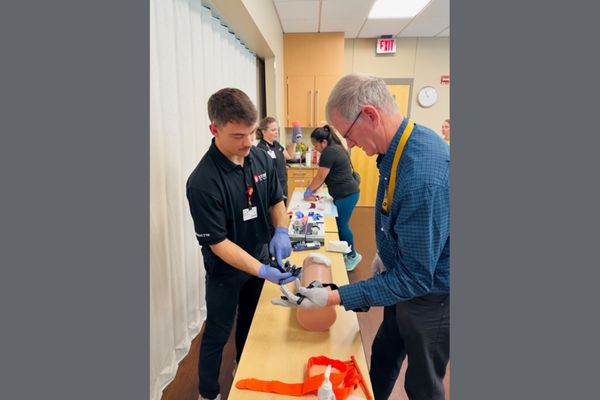
Health educators Jared Myers and Erin Clubb lead my class. “I’ll keep an eye on you,” Erin says. “My daughter is also squeamish around blood, and I would love for her to the take the class.”
“How long does it take for someone to bleed out?” Jared asks. Three to five minutes.
“How long does it take for EMS to arrive?” Seven to 11.
I hold a tourniquet and a roll of gauze. Both could fit in my purse.
“Fear is the little-death that brings total obliteration.”
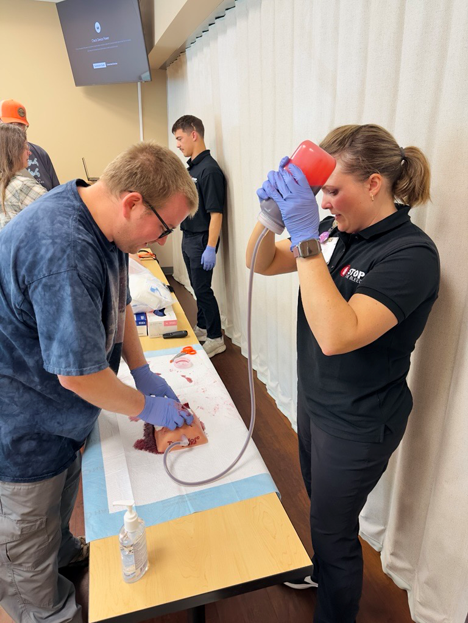
I compress a leg wound. Jared redirects me. Don’t use the whole roll of gauze stacked on top, it reduces your force. My compression isn’t enough to stop the bleed. I pack the wound. Jared shows me how to use my thumb to get more gauze in. It’s still not enough. Tourniquet. I put it on backward. If I swap, Jared says, I’ll have more force to tighten. I didn’t know tourniquets could cause so much pain. They might be screaming, he said, tell them you are here to help. Good Samaritans, Erin says. Jared shows me just how tight it can go. The wound trainer dummy’s “flesh” flexes. We go as tight as our strength allows, Jared says. Then you mark the strap with the time. Don’t have a pen? Write it in blood.
“I will face my fear.”
This wound was dry. Now to wet. We’re practicing on a gunshot wound, Erin says.
“I will face my fear.”
I’m too eager to make it stop. Wait until the bleeding starts through the wound, she says, so you can see it and know what it will look like. I’m too neat (slow) with the gauze roll. Toss it, she says, get it open.
I’m gloved, but I can already feel it soaking through the compression. So, on to packing. I can feel everything. You got it, Erin says, push it down far and pack it in. Then back to compression with the full weight of my body. I can’t stop until EMS taps my shoulder.
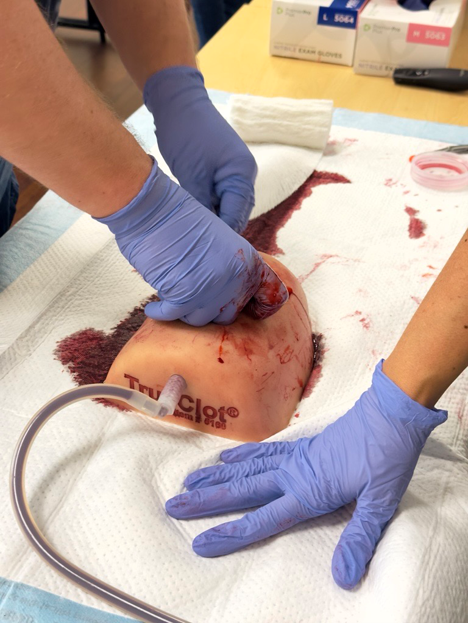
“I will permit it to pass over me and through me.”
I watch others. A few go back to practice more. Many ask questions.
Nancy wants me to go again. She wants photo evidence for my team that I did not, in fact, pass out.
My second go with the wet wound. I’m here to help you, I say. The earth fissures. All I can see is my kids. I break.
“And when it has gone past, I will turn the inner eye to see its path.”
“It happens a lot in our infant CPR classes,” Nancy says. “It makes sense. It feels real and your mind goes to ‘What if I really have to do this?’”
A community member asks how much the training will cost his group.
It’s free, Erin says.
I hold my certificate and exit to a shock of blue and sun. I replay the steps as I walk to my car. A roll of gauze in my hand under trees older than me. Birds titter. A cart rolls. Staff pass by to clock in. Returning, day after day, to serve.
“Where the fear has gone there will be nothing. Only I will remain."
Take action
- Learn more about the American College of Surgeons Stop the Bleed program
- Learn more about the CHEC’s Stop the Bleed class
- See the full suite of CHEC’s community safety and injury prevention classes
- See the current schedule of CHEC classes and sign up
To schedule a community class with your group, call 503-814-2432 or visit salemhealth.org/chec.
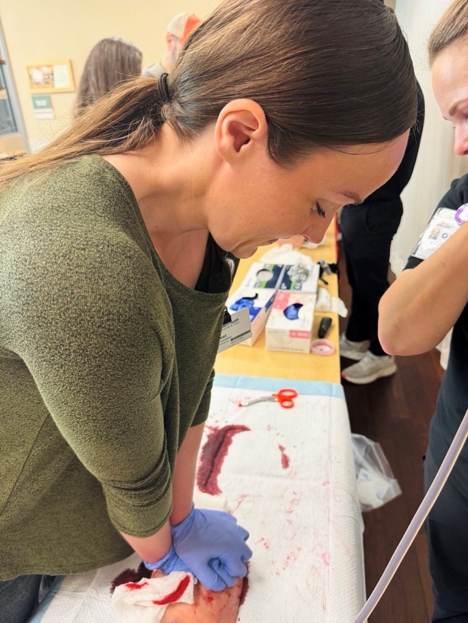
The author applies pressure to an artificial wound.