Swing bed program: ‘The people there really care. It’s not just a shift for them.’
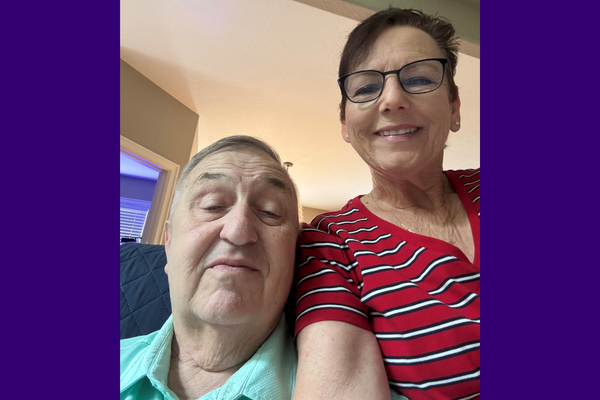
On Jan. 19, Evelyn Lucas was talking to her husband Pat, and she couldn’t make out what he was saying.
“I realized something was wrong,” she said. “We got to the Salem Hospital Emergency Department in 15 minutes.”
A CT scan showed Pat was having a stroke, and he stayed for observation.
“They brought a team in and realized he had a massive brain bleed,” said Lucas. “It was very frightening, and we were in intensive care at that point. Thirteen days later we learned he needed brain surgery.”
Searching for care after surgery
Lucas said she worried about her husband’s options for recovery after being discharged from the hospital. Fresh out of surgery, he could not walk on his own.
“I was terrified to bring him home,” said Lucas. “How was I going to handle him?”
Coming home wasn’t a safe option, but the intensive care unit wasn’t the right fit either.
“I was worried they would send him to an old folks’ home to pass away,” she said. “But I went to see West Valley Hospital first and found out the transitional care program is affiliated with Salem Hospital — which I felt very secure at.”
With Lucas feeling reassured by her visit, Pat was released into the West Valley Hospital inpatient therapy program (also known as the “swing bed” program) in early February.
Lucas said insurance covered one week of transitional care. Within that single week, the team at the Dallas hospital had her husband up and walking.
“They had the ability, the knowledge and the tools to help my husband get to where he is today,” she said. “The people there really care. It’s not just a shift for them.”
Pat’s next step: Home at last
Building on his success, Pat’s stay in Dallas was extended. Then he was transferred to Inpatient Rehabilitation at Salem Hospital for another two weeks, where he continued to improve.
Pat came home in late March and is currently going through outpatient therapy at the Salem Health Rehabilitation Center. Lucas said her husband wouldn’t be where he is today without the initial care he received at West Valley Hospital.
“They pushed him along and encouraged him,” she said. “They’re an incredible team down there. They’re funny and they really cared. I’m forever grateful.”
Pat had just retired at age 73 in September, and Lucas said the stroke was very unexpected.
“Everybody told me it was going to be ok, and it was going to get better,” she said. “I watched the nurses closely, and they just made me feel like it was all going to be alright.”
Now Pat is talking and walking again as he recovers at home.
“I was worried about bringing him home … none of our children live in-state,” said Lucas. “But through the help of West Valley staff, we’re making it. He’s really happy to be alive.”
Your path to recovery
The West Valley Hospital swing bed unit offers recovery care after surgery and serious illness. This helps people build back strength and skills to return to daily life. Physicians, therapists and pharmacy staff provide coordinated care after discharge to restore patients to previous levels of independence.
In 2025, the average patient was in swing bed transitional care for 14 days, roughly half the national average. More than 75 percent of patients were able to return home after their stay rather than being sent to a nursing home or another hospital. This compares to 51 percent nationally. Less than 20 percent of West Valley swing bed patients were readmitted back to the hospital for their original diagnosis.